Showing posts with label #dimentia. Show all posts

Saturday, September 3, 2022

How much does Medicare Cost? (2023)


 If you don't have to use Medicare, then it is relatively inexpensive.  As you get older though, more things go wrong with your body that eventually start to add up. Just like you don't buy the car insurance after the accident, you don't want to wait until something happens before purchasing coverages that pays for what Medicare doesn't cover. For that reason, let's look at the potential costs that could add up.

The complete package of Medicare includes Parts A, B, C, and D.  To keep it short and simple, part A covers the hospital costs.  Part B covers your doctors costs and part D covers your prescription drugs.  Part C has two options but you can't have both.  You either get a Medigap plan otherwise known as a Medicare Supplement plan, or a Medicare Advantage plan.

If you worked 10 years of your life and payed through FICA you will qualify for part A, otherwise you will have to pay for it.  Part B is something you have to sign up for and is currently costing $170.10 a month and will come out of your Social Security check. You will also need to sign up for part D. Not signing up for parts B and D could cost you by way of a penalty in years to come. 


Where it tends to get gray is in Part C. That is because it depends on the type of plan you favor.  Do you prefer upfront costs and reduced back end charges?  Or, do you prefer less front end charges but you will pay as you go?  In general, a Medicare Supplement will cost more in premium but will possibly not cost you much after you pay the deductible for the year.  Some popular supplements are G and N.  Plan F is still available if you were 65 before Jan. 1, 2020.  You could find one of these plans for $100 a month or so.  Your current part B deductible is $233. Roughly for only $1433 a year plus the cost of your Part D you would have BASIC coverage.

On the other hand, a Medicare Advantage plan would not have as high of a premium. Many have a $0 premium but this is where it gets tricky.  These plans are like many employer plans in that you pay something to your doctor every time you visit. If you read the policy carefully, the plan states you pay for services such as emergency room service, outpatient care, mental help, and so on.  Each policy is different, so you may also have to pay for transportation such as an air ambulance. They may include dental, vision, and hearing but one visit could be the maximum that plan would pay for the year so the rest of your visits would be out of your pocket.  Finally, these plans have a maximum out of pocket expense which could be in excess of $10,000 ANNUALLY. Neither plan will cover costs that are unapproved by Medicare.

Next, depending on your family history it may be necessary to add extra coverage to Part C. These plans pay you back for your expenses which don't have to be medically related.  Most common areas are for cost that arise when having Cancer, Heart Attack, Stroke, some accidental coverage, and reimbursement for those medical expensed listed above, emergency services, outpatient, etc.  This money comes to you for you to use it as you see fit.  After all, the bills don't stop just because you are laid up!

As you can see, the true cost of Medicare depends on what you mean when asking the question.  If you elect not to get a Part C plan, and you can do that, it can really add up but again depends on your medical history or an unexpected accident. If you
have further question or would like to talk to a licensed representative visit https://retirementconcerns.info


Wednesday, September 1, 2021

Home Health Care vs Home Care: The REAL MONEY PIT

 People I meet who have older parents, tell me all the time they were surprised by the cost involved taking care of their parents. They were under the assumption Medicare, and/or their parents part C plan would cover these expenses. This is, why we are discussing Home Care and Home Health Services. 

When you decide to take care of someone, or have someone take care of you, there are many considerations to ponder. If you have a child, remember when that child was incapable of taking care of themselves? You took them from point A to point B.  You filled their drinking cup and put a lid on it so they wouldn’t spill it all over.  You also probably fed them until they could hold a spoon. I’m sure you dressed them at least once a day and bathed them. Then there is that part most people find repulsive, toileting. Offensive foul odors beginning to come to mind now? That child had no concept of privacy only that his needs were met.

Now let’s turn the tables. You have been caring for yourself for 70 years or longer and your child has been taking care of himself/herself for 48 years.  You are no longer able to walk, hold a cup of coffee, or food on a spoon, and you need to relieve yourself. They have promised solemnly to take care of your every need except they have never seen you in such an infantile way. There is also the matter of taking care of their family. They live 200 miles away and both work. Do you move in with them or do they take time off? Additionally, they don’t have the credentials to provide skilled care. What do you do? Do you get HOME CARE, HOME HEALTH CARE, or something else?

First, the above scenario is typical designed to get you and your family to talk about events post retirement.  Home Health Care is what happens after you leave from a service in the hospital. CMS states, “Home health care includes skilled nursing care, as well as other skilled care services, like physical and occupational therapy, speech -language therapy, and medical social services. These services are given by a variety of skilled health care professionals at home. The home health staff provides and helps coordinate the care and/or therapy your doctor orders. Along with the doctor, home health staff create a plan of care, which is a written plan for your care. It tells what services you will get to reach and keep your best physical, mental, and social well-being. The home health staff keeps your doctor up-to-date on how you are doing and updates your plan of care as needed, as authorized by your doctor” Does Medicare cover this or your part C? Possibly!


Sunday, September 15, 2019

Ten Signs you or someone you know may have dementia


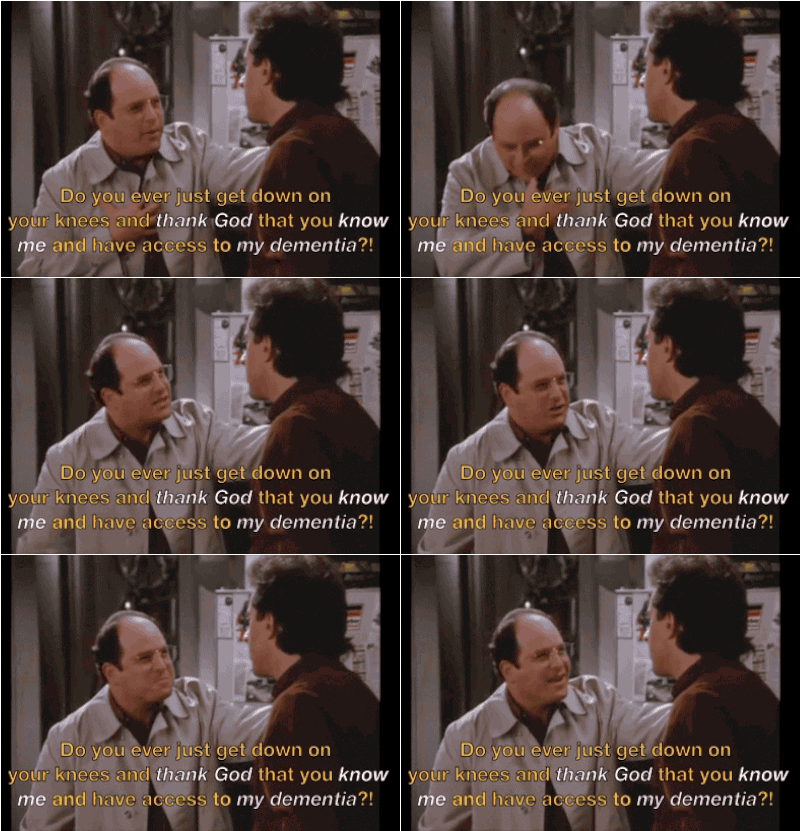
The Seinfeld sitcom had a reputation for making lite of life's moments, but for those who know someone impaled by the disease, THIS IS NO LAUGHING MATTER. Similar to Alzheimer's, the disease can last a very long time.  #Dementia is not a specific disease. It's an overall term that describes a group of symptoms associated with a decline in memory or other thinking skills severe enough to reduce a person's ability to perform everyday activities. Alzheimer's disease accounts for 60 to 80 percent of cases. As such, Dementia like Alzheimer's requires "care for the long term"

Causes may vary from short term to more serious irreversible symptoms.

Causes of dementia may include:

Common causes of reversible dementias:
  • Depression
  • Medication (side effects, drug interactions, drug overdose
  • Alcohol abuse
  • Drug abuse
  • Dietary, vitamin and mineral deficiencies (A, C, B-12 and folate)
  • Traumas (due to falls, concussions or contusions to the head)
  • Hormonal dysfunction (thyroid problems)
  • Metabolic disorders (dehydration, kidney failure, COPD)
  • Infections
  • Heart disease
  • Brain disease (tumours)
  • Environmental toxins
A less publicized argument is posed by Dr. Perlmutter, MD. Renowned neurologist David Perlmutter, MD, blows the lid off a topic that's been buried in medical literature for far too long. Carbs are destroying your brain. Not just unhealthy carbs, but even healthy ones like whole grains can cause dementia, ADHD, anxiety, chronic headaches, depression, and much more.

Symptoms

Like activities of daily living, having two or more of these signs may be an onset of dementia

  • Memory loss
  • Difficulty planning or solving problem
  • Difficulty doing familiar tasks 
  • Being confused about time or place
  • Challenges understanding visual information
  • Problems speaking or writing
  • Misplacing things
  • Poor judgment or decision-making
  • Withdrawal from socializing
  • Changes in personality or mood
That being said, it is worth taking precautions early to reverse dementia where possible.  Currently, there is NO cure for dementia.  Treatment methods vary and may not necessarily be safe. Of course, with any medical issue, it's always wise to consult your physician or a specialist.


#dementia #aging #Alzheimer's #menshealth #womensheatlh #brain #cognitiveimpairment #mentalhealth