Sunday, September 15, 2019

Ten Signs you or someone you know may have dementia


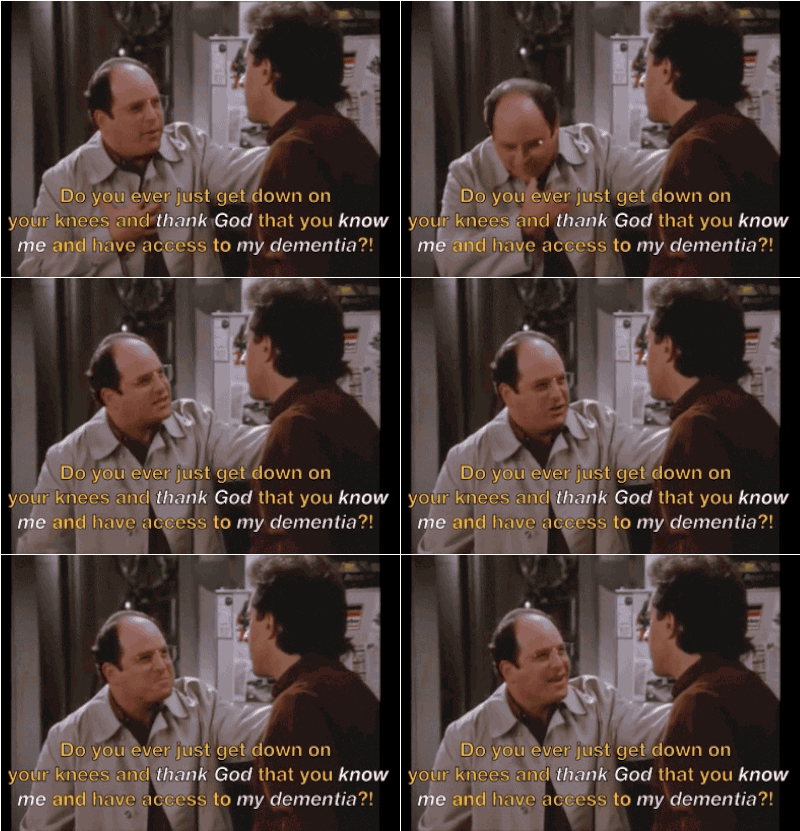
The Seinfeld sitcom had a reputation for making lite of life's moments, but for those who know someone impaled by the disease, THIS IS NO LAUGHING MATTER. Similar to Alzheimer's, the disease can last a very long time.  #Dementia is not a specific disease. It's an overall term that describes a group of symptoms associated with a decline in memory or other thinking skills severe enough to reduce a person's ability to perform everyday activities. Alzheimer's disease accounts for 60 to 80 percent of cases. As such, Dementia like Alzheimer's requires "care for the long term"

Causes may vary from short term to more serious irreversible symptoms.

Causes of dementia may include:

Common causes of reversible dementias:
  • Depression
  • Medication (side effects, drug interactions, drug overdose
  • Alcohol abuse
  • Drug abuse
  • Dietary, vitamin and mineral deficiencies (A, C, B-12 and folate)
  • Traumas (due to falls, concussions or contusions to the head)
  • Hormonal dysfunction (thyroid problems)
  • Metabolic disorders (dehydration, kidney failure, COPD)
  • Infections
  • Heart disease
  • Brain disease (tumours)
  • Environmental toxins
A less publicized argument is posed by Dr. Perlmutter, MD. Renowned neurologist David Perlmutter, MD, blows the lid off a topic that's been buried in medical literature for far too long. Carbs are destroying your brain. Not just unhealthy carbs, but even healthy ones like whole grains can cause dementia, ADHD, anxiety, chronic headaches, depression, and much more.

Symptoms

Like activities of daily living, having two or more of these signs may be an onset of dementia

  • Memory loss
  • Difficulty planning or solving problem
  • Difficulty doing familiar tasks 
  • Being confused about time or place
  • Challenges understanding visual information
  • Problems speaking or writing
  • Misplacing things
  • Poor judgment or decision-making
  • Withdrawal from socializing
  • Changes in personality or mood
That being said, it is worth taking precautions early to reverse dementia where possible.  Currently, there is NO cure for dementia.  Treatment methods vary and may not necessarily be safe. Of course, with any medical issue, it's always wise to consult your physician or a specialist.


#dementia #aging #Alzheimer's #menshealth #womensheatlh #brain #cognitiveimpairment #mentalhealth


Monday, September 9, 2019

Why buy life insurance for kids?

Why buy life insurance for kids?????


Recently, I had the opportunity to provide life insurance to a young man starting his journey as an adult.  The same day I hear on the news that a child got shot AGAIN in Durham, NC. The emphasis here is another child hit, not the town. The day before a report aired about a child kidnapped. Last night, as of this writing, three kids stabbed by their father.  Every year when school starts, children get hit by someone failing to stop for a school bus. Every summer some child drowns in the local lake somewhere.  This got me to thinking, Does it make more sense today to buy life insurance for kids?  Am I being paranoid? 

Does place of ones house matter?


Where there are more people, one would expect to find more deaths per 100k.  According to the Henry Kaiser Family Foundation there may not be a correlation. They state further, some rural states have higher child deaths per 100k than more populated states.

Does financial status matter?


If you have money set aside, other plans can prepare for such an occasion and beyond. Ask your yet, can I afford $3k to $14k per child for unexpected burial expenses?  Those figures depend on several variables. If you cant, it is worth giving considerable attention to. Once you are up and running, other planning considerations may be necessary.

What are the odds?


Why would someone think about gambling on their child's life?  Always hedge your bet! Would you rather pay the small cost of a premium now, or the full cost of a funeral then? Is it worth less than the cost of a soft drink per day to have peace of mind? #lifeinsurance #children #mortality #ltc-ab2.info #funeral #deaths

Monday, August 26, 2019

Are we being lied to?


Are we being lied to?

Don't stop at the first paragraph! The picture appeared in an #opioid article I saw this week prompting the thought.  Do we even know what a lie is anymore?  The website dictionary.com gives one definition to a lie as "something intended or serving to convey a false impression".  Interestingly, the same website defines an illusion as "something that deceives by producing a false or misleading impression of reality." Whether it's called #word-smithing, #positioning, or something else by liberal interpretation isn't it all a lie? If you have a bad product, potentially harmful side effects, etc. divert their focus and they'll buy every time. Guess who pays the cost!

Am I different from everyone else?  Over my lifetime, I have looked for answers to various questions for both knowledge and a better way of life.  It has led me to be skeptical about everything.  As one person once said, "Follow the money." The end result will be the truth behind everything.  From deceptive, seductive foods, to trashy products, fake people, ultimately, there seems to be great truth behind this statement. 

It's never too late to discover the truth, the reality, to seize the day.  Don't be afraid to read and research!  We have addictive personalities.  Sometimes it is not our faults as we realize the cravings, desires, etc created by the drugs, chemicals, pleasure affects we consume. #Weight, #diabetes, #dementia, and a multitude of other health issues can be reduced, eliminated, controlled simply by being aware of the causes.  #Join me or #follow me as we discover the truth together.

Tuesday, August 20, 2019

AMC and You


AMC and You


In a land far far away, at least from my present location, my first management experience was the custodial care business, more appropriately called #Environmental Services.  I was taught most people tend to look out and down when they clean ignoring the details. The same can be said of one's present health conditions.  We tend to look at the present, not the future possibilities. When it comes to your Medicare, do you have Alternate Means of Coverage?

What do I mean?  

Watch the Video!


If you watched the video you discovered, Medicare will cover medical expenses, if they are both #MEDICALLY NECESSARY  and #MEDICARE APPROVED.  Let's say you needed more care after your 100 days of skilled nursing, you could be responsible for the cost.

Know the terms

More importantly, it is essential to be aware of the terms that describe qualifiers.  Being kept for observation is not considered an admission.  Therefore, if you were not been admitted to the hospital for 3 days or more, you may not qualify for skilled nursing.

Know the types and costs of available care 

If you become afflicted with #Alzheimer's or had other medical issues, you may want home health care. The family will cover that? It could last up to 20 years and gets progressively worse over time.  Will the family last that long? For an estimate of the cost for long term care types and
their costs go to https://www.genworth.com/aging-and-you/finances/cost-of-care.html.

Know when you may need more Alternate Means of Coverage

Typically, the reasons one needs Alternate Means of Coverage are numerous. Some of the primary reasons are:  
  • Stroke
  • Cancer
  • Injury induced by fall or other activity
  • Dementia, Alzheimer's, or other mental illness
  • Diabetes
  • Obesity
  • Nervous system disorders (ex. Parkinson's Disease, Multiple Sclerosis)
While these may occur at any age, as we get older the chances of their occurrence increase. 


If you are like most people, today you are probably thinking this won't happen to me! It doesn't hurt to know the odds and be aware of them rather than ignore them and be unprepared.


As you discovered, this was about getting over the misnomer of long term care.  These days going to the "old folks" home or "nursing home" is not the extent of long term care.  The types of care we need are as varied as the events in life that cause them.  For more information go to my website and select the video of your interest.

Tuesday, August 13, 2019

What do you know about the cost of diabetes?

THE COST OF DIABETES

Did you know that of the total #medicalexpenses paid for by diabetics, more than half of the costs were for diabetes?  "Average medical expenditures for people with diagnosed diabetes were about $13,700 per year. About $7,900 of this amount was attributed to diabetes."
Diabetes was listed in 2015 as the seventh leading cause of death in the United States.  As of 2017, that cost had doubled. "Care for a person with diabetes now costs an average of $16,752 per year. As in prior reports, the 2017 analysis also documents substantial indirect costs related to lost productivity due to diabetes and its complications."  Doesn't it then make more sense to control diabetes and not the costs? Controlling diabetes with more medicine or improved care only raises costs.  Controlling diabetes at the root cause reduces the need for medicine.

What is the root cause of diabetes?  To understand this one must understand the bodily process involved.

"Diabetes is a disease caused by excess insulin, not excess blood sugar. In other words, high blood sugar is a symptom, but not the root cause. Insulin is the hormone responsible for reducing blood sugar. In order for insulin to work, our tissues have to be sensitive to its action; otherwise, tissues become resistant and insulin struggles to clear out sugar from the blood. As insulin resistance sets in, the first organ to stop responding to insulin is the liver, followed by the muscles and eventually fat. How does insulin resistance begin? The root of the problem is our diet."

If the root cause of diabetes is our diet, then wouldn't it be logical to reduce if not eliminate diabetes by altering our diet?  Reducing the causes of increased blood sugars would then reduce the body's production of insulin.

What causes the body to produce insulin?  

"After eating #carbohydrates, the carbs break down into #sugar, trigger the pancreas to produce #insulin and are then stored in the liver and muscles. However, there is a limit to the amount of sugar the liver and muscles can store. The easiest way to understand this is to think of your liver and muscles as small closets without much storage space. If sugar keeps coming in, the closet will quickly fill up."

What are #carbohydrates?

"Carbohydrates are a primary source of food your body uses for energy. These include simple carbohydrates (such as honey, table sugar, and high-fructose corn syrup), as well as complex carbohydrates. Complex carbs include starches (such as bread, pasta, rice, and potatoes) and dietary fiber (found in fruits and vegetables, nuts, and whole grains)."

In addition to the complex carbohydrates, it's also important to reduce the products they came from, wheat and grains. They cause what is called #wheatbelly.  Also, they clog the body's system for digesting food, creating that inner-tube effect.   Ironically, carbs are known as seduction foods creating craving and hunger feelings. 

The End Result!

What have we seen here?  Reducing cravings reduces the dependency on insulin-producing foods. If there is no need for these foods, the body doesn't need to work so hard producing insulin.  If the body doesn't need to produce so much insulin, there would be less need for diabetic medication. The end result then would be a reduction of food costs, cost of medication and a side benefit, #WEIGHT LOSS.


Tuesday, August 6, 2019

The unexpected Cost of Cancer


The  unexpected Cost of #Cancer


Things just don't feel right so you decide to go see the doctor for a checkup.  To your horror, you find out you have cancer.  You have medical insurance right?  So there is nothing to be concerned about right?  WRONG!  

The cost of #co-pays and #deductibles alone can be stressful financially and emotionally.  "Patients with the greatest financial stress spent about 31 percent of their household income on health-related costs, not including insurance premiums." For many, they soon come to feel "underinsured".

Personal expenses depend on several factors.  Among them: The type of cancer treatment you receive. The length of treatment. The location of treatment. Your health insurance coverage. Whether you have supplemental insurance.  In addition, there are many unexpected costs.  These include Transportation and travel expenses like Gas, Tolls, Parking, Taxis, Bus or train fares, Airplane fares. Family living expenses include Childcare, Eldercare, Support for household tasks like cleaning, and Counseling. 

You may need care at the home or away from home. Consider the cost of hiring a person to prepare meals or provide transportation to appointments, Staying at a specialized facility for extended nursing care, or Hiring a home health aid. 

Finally, do you think you will be able to work during this time? What about legal issues that may occur if your employer terminates your employment.  How about financial issues like filing taxes? 

If you don't already have cancer, now then is the time to consider the cost.  While the exact amount may not be completely calculatable, any income replacement plans would be beneficial.  


Wednesday, July 31, 2019

#Medicare for all? A wholistic approach

#Medicare for all? 
A Wholistic Approach

Certainly discussing this topic today is a sticky or controversial subject. Both sides, assuming there are only two, are very adamant for their beliefs. Years ago, I managed long term stay hotels so I was often privy to persons venting.  Where there was a relationship, I got to hear his side of the issue, and I got to hear her side.  Somewhere in the middle is the "true" truth! I approach most big decisions with the same mentality as the old Dragnet detective, "the Facts ma'am, nothing but the facts".

Opinions aside, one concern is the cost.  It's interesting to note in this linked article, more of the GDP comes from health care in the US than in other countries.  It is also interesting to note his comment that Americans are sicker than other countries. Is it fair or reasonable either to assume one size fits all? With America's uniqueness, would #Medicare for All have what it takes to execute?

What about the quality of care?  While in college I worked in a hospital, also known as a teaching hospital, next to one of these "big name" clinics.  Around town, people were led to believe by clinic doctors one received better care than by those not a part of the group.  Well, guess what! I will never forget the words of the cardiac surgeon from the clinic deifying his skills.  The "outside" but local cardiologist seemed embarrassed.  The forty-seven-year-old male passed on the table. Was he ready for surgery?  How could two well-trained heart doctors make such a mistake? So will the quality of care really be different as this one argument suggests? 

Is there another side to the "true truth"? As mentioned above in the first article, a note was made to the sickness of the American public.  Why are Americans sicker than those in other countries?  Is anything being done about changing these results?  Is it possible to affect this issue in some way? Multiple sources have tried to sound this alarm but it seems that Americans are caught under a hypnotic trance or spell, seduction, or complete denial.  In his book,# Grain Brain, Dr. Perlmutter list a smorgasbord of cognitive impairments brought on by our alleged "healthy diet".  Also, William Davis, MD in his book #Wheat Belly list even more medical issues.  Both and others debunk the traditional Food Pyramid.  A disproportionate midsection certainly leads to other major health issues.  One might not come to realize the effect of their lifestyle until their later years, however, undergoing the change in lifestyle now can extend the latter years significantly reducing the cost of medical care in the future.

Thus the final question really should be, in my humble opinion, "Do we really want care for ALL?"  Or, can we find alternative ways to eliminate the need for care for many by simply re-educating the public to better care for themselves?